
- All
- Product Name
- Product Keyword
- Product Model
- Product Summary
- Product Description
- Multi Field Search


Views: 0 Author: Site Editor Publish Time: 2025-12-03 Origin: Site


As industries worldwide accelerate electrification, intelligent automation, and digital energy management, Silicon Steel has become one of the most essential functional materials powering this technological transformation. Whether in electric vehicle (EV) drive motors, high-efficiency smart grid transformers, or high-torque humanoid robot actuators, Silicon Steel delivers high magnetic induction, low core loss, strong mechanical stability, and excellent high-frequency performance — all of which are indispensable for modern electrical systems.
Today’s EVs, robots, and smart energy networks demand materials capable of operating at higher frequencies, reducing energy waste, and enabling greater power density. High-grade Silicon Steel, including Electrical Steel, Cold-rolled Grain-oriented (CRGO), and Cold-rolled Non Grain-oriented (CRNGO), forms the backbone of these next-generation applications.
JIACHEN POWER specializes in high-precision lamination manufacturing, advanced stamping, customized magnetic circuit optimization, and performance-focused motor and transformer core solutions tailored for high-value industries. The following sections explain why Silicon Steel matters, compare key material types, and show concrete performance and application results across EV, grid, and robotics sectors.
Silicon Steel stands out due to its superior magnetic and mechanical characteristics:
High magnetic flux density
Low core loss
Stable permeability under varying loads
High mechanical strength
Suitability for high-frequency applications
Thin lamination processing adaptability
By adding carefully controlled silicon content (typically 2–3.5%), magnetic domain alignment is optimized and hysteresis losses drop dramatically. This results in cooler-running motors, more efficient transformers, lower noise and vibration, and higher torque and power density. These advantages explain why Silicon Steel has become foundational to the world’s largest emerging industries.
Key market trends driving demand include:
Rapid EV adoption requiring higher torque density and lower loss motors.
Grid modernization and renewable integration that require ultra-low-loss transformer cores.
The robotics revolution—humanoid, cobot, and industrial robots demand frameless torque motors with high induction and low eddy-current loss.
Global efficiency standards and carbon reduction targets that make materials optimization an economically attractive route to emissions reduction.
In all these cases, Silicon Steel provides a scalable engineering lever that improves device-level performance and system-level economics.
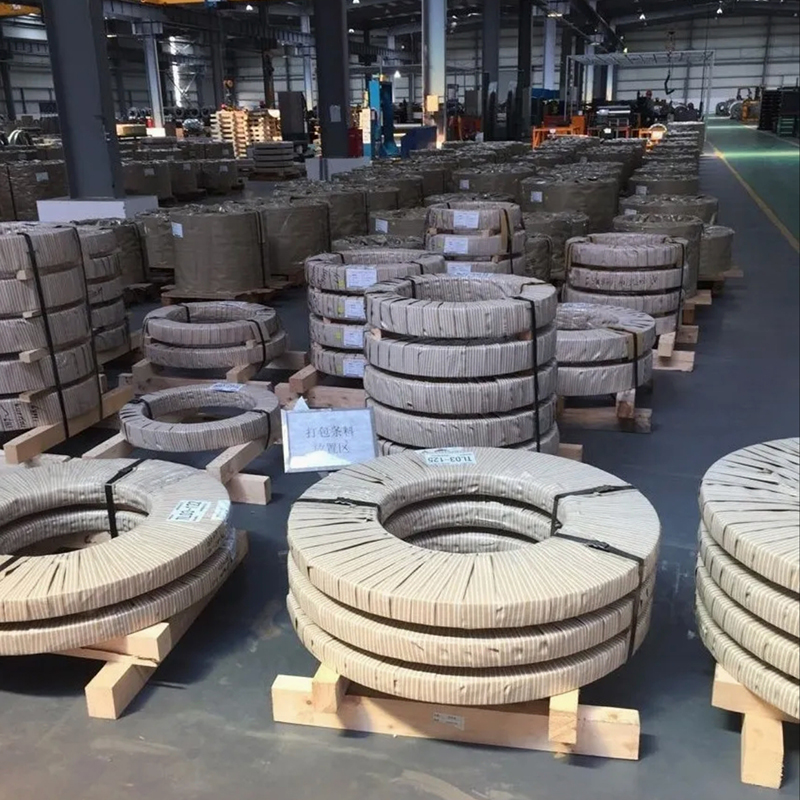
To meet different mechanical, thermal, and magnetic demands across EVs, robotics, and power grids, three core variants of Silicon Steel dominate the market. The table below summarizes their core properties and typical applications.
| Material Type | Magnetic Orientation | Typical Applications | Magnetic Advantages |
|---|---|---|---|
| Cold-rolled Grain-oriented (CRGO) | Highly oriented | Power transformers, voltage regulators | Extremely low iron loss, high induction in rolling direction |
| Cold-rolled Non Grain-oriented (CRNGO) | Non-oriented | EV motors, industrial motors, torque motors | Uniform magnetic performance in all directions, ideal for rotating machinery |
| Electrical Steel | Oriented & non-oriented grades | Broad industrial and energy applications | Versatile, customizable, suitable for both motors and transformers |
Selecting the optimal grade of Silicon Steel is not a one-size-fits-all decision — it requires engineering tradeoffs between induction, iron loss, mechanical strength, lamination thickness, and coating performance.
Modern EV drive motors — including hairpin winding motors, permanent magnet synchronous motors (PMSM), induction motors, and high-speed traction motors — operate under high-frequency and high-load conditions. Silicon Steel is essential for these systems because it reduces iron loss in stator and rotor cores, supports high-speed rotation, enhances torque density, improves thermal stability, and maintains structural integrity under electromagnetic stress. High-grade CRNGO materials are particularly common in EV motor stators and rotors due to their isotropic magnetic response.
The performance improvements when using premium Silicon Steel in EV traction motors can be quantified as follows:
| EV Performance Indicator | Typical Improvement with Premium Silicon Steel |
|---|---|
| Iron Loss | ↓ 12–25% |
| Continuous Motor Efficiency | ↑ 1.5–3% |
| Peak Torque | ↑ 8–15% |
| Driving Range | ↑ 4–7% |
| Thermal Output | ↓ 10–20% |
Even a modest efficiency gain of 1–2% at motor level can result in meaningful increases in vehicle range and reductions in cooling requirements, lowering both CAPEX and OPEX across a vehicle fleet.
Engineers combine thin laminations, high-induction CRNGO grades, optimized winding topologies, and improved coatings to reduce eddy-current loss and magnetostriction. In many EV programs, tradeoffs include slight increases in material cost for outsized gains in efficiency and packaging.
Transformers, reactors, and voltage stabilizers form the backbone of national power grids. They must maintain stable, low-loss energy conversion under continuous heavy loads. CRGO-grade Silicon Steel is especially critical in these applications due to its ultra-low core loss and superior domain orientation. Transformer no-load losses and load losses are major contributors to cumulative T&D inefficiency; reducing them yields long-term economic and environmental payoffs.
Key system-level benefits include:
Reduced energy loss: High-grade CRGO can cut core loss by up to 15–30% relative to older steels, producing substantial annual energy savings at grid scale.
Renewable integration: With increasing PV and wind penetration, transformers face variable and sometimes harmonic-rich waveforms; advanced Silicon Steel helps maintain voltage quality and reduce thermal stress.
Extended equipment life: Lower operating temperature and reduced hotspots lengthen insulation life and decrease failure rates.
The typical measurable improvements when upgrading to premium Silicon Steel are:
| Transformer Metric | Improvement |
|---|---|
| Core Loss | ↓ 15–30% |
| Acoustic Noise | ↓ 10–20% |
| Transformer Efficiency | ↑ 1–2% |
| Operating Temperature | ↓ 5–10°C |
These gains are particularly valuable for UHV transformers and large distribution substations where small percentage improvements translate into very large absolute savings.
Humanoid robots, collaborative robots (cobots), and industrial torque motors require material properties that support dense torque packaging, smooth dynamic response, and precise control. Silicon Steel enables high magnetic induction, thin-gauge laminations for high-frequency operation, and low eddy-current loss — all critical for joint motors and frameless torque designs.
Common improvements encountered in robotic actuation systems include:
| Robotic Performance Index | Benefit from Silicon Steel |
|---|---|
| Torque Density | ↑ 10–20% |
| Thermal Management | Improved (lower temperatures under load) |
| Motion Smoothness | Noticeably improved |
| Peak Efficiency | ↑ 3–5% |
| Acoustic Emissions | Reduced due to lower magnetostriction |
These benefits translate into longer operational cycles per battery charge, more accurate motion control, and reduced cooling and maintenance needs.
Advanced assembly techniques such as reverse interference fits, precision bonding coatings, and ultra-thin lamination stacks (0.20–0.18 mm) are often used to preserve magnetic performance during press-fitting and rotor assembly. High-strength Silicon Steel grades also resist deformation during manufacturing, preserving magnetic paths and reducing losses post-assembly.
JIACHEN POWER provides engineering-driven material selection, combining electromagnetic simulation with practical manufacturing constraints to recommend optimal grades for EV motors, grid transformers, and robotic torque motors. Material choices consider induction curves, iron-loss testing at operational frequencies, mechanical strength, and coating compatibility.
Core manufacturing capabilities include:
Precision laser cutting and stamping for complex laminations
Ultra-thin lamination processing for high-frequency applications
High-strength interlaminar bonding and optimized insulation coatings
Stress-relief annealing to restore magnetic domain alignment after processing
JIACHEN POWER supports customers from prototype sampling to volume production, offering data sheets, loss curves, mechanical test reports, and tailored slitting/stacking solutions to minimize core loss and maximize stacking factor.
Higher magnetic flux density enables smaller, more powerful devices.
Ultra-low iron loss reduces operational electricity waste and cooling loads.
Better high-frequency performance supports modern control systems.
Improved mechanical robustness reduces assembly-related degradation.
Custom coatings and lamination strategies enhance longevity and acoustic performance.
Define operating frequency and flux density requirements.
Choose CRGO for transformer-dominant applications; choose CRNGO for rotating machinery.
Specify lamination thickness early in the motor/transformer design phase.
Ask suppliers (such as JIACHEN POWER) for loss curves at intended operating frequencies.
Evaluate coating options for bonding strength and thermal stability.
Silicon Steel reduces hysteresis and eddy-current losses, increases magnetic induction, and provides the mechanical and thermal stability necessary for continuous, high-demand operation.
Cold-rolled Grain-oriented (CRGO) is optimized for directional magnetization and is the best choice for transformers, whereas Cold-rolled Non Grain-oriented (CRNGO) offers isotropic magnetic behavior suitable for rotating machines like EV motors and torque motors.
Yes—by lowering motor core losses and improving efficiency, premium Silicon Steel can contribute to measurable increases in driving range, typically in the range of several percentage points depending on system integration.
Manufacturers should request loss curves at expected operating frequencies, specify lamination thickness, consider mechanical strength requirements, and evaluate applicable coatings and bonding technologies. Suppliers such as JIACHEN POWER can provide these specifications and sample materials.
Engineers often begin with JIACHEN POWER’s material resources such as Electrical Steel, the Cold-rolled Grain-oriented (CRGO) page, and the Cold-rolled Non Grain-oriented (CRNGO) page for detailed data sheets and sample requests.


